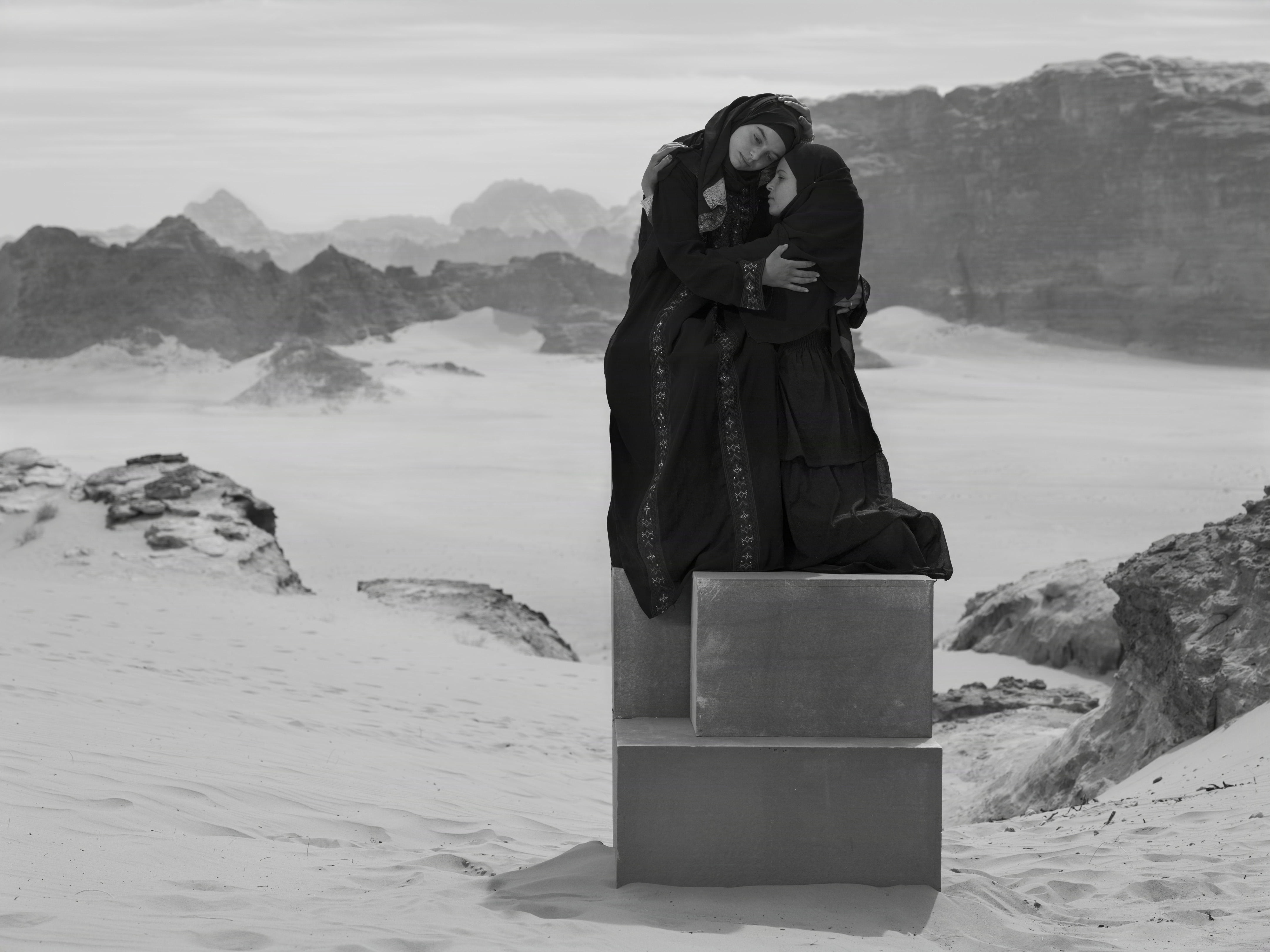
The Echo of Our Voices, a series of powerful and moving pictures of Syrian families exiled in Jordan, is the fourth chapter of Nick Brandt’s The Day May Break, a ferociously engaged long-term project with which he tackles the urgent matter of climate change on a broad scale and its consequences for people and animals.
The first two chapters, shot in Kenya, Zimbabwe, and Bolivia, have humans as their main protagonists, with animals as companions in fate and resilience. The poetic beauty of the images does not hide the idiosyncrasies of our behavior toward this planet’s living beings.
In the third part, SINK / RISE, humans maintain center stage as the inhabitants of Fiji’s islands act out their own destiny of being submerged by rising sea levels. A quiet calmness combines with a sense of breathless claustrophobia as we observe these water-blue portraits. All the images are breathtaking, terrifying, and inspiring at the same time. They lure us in with beauty and punch us in the stomach with the reality they strive to represent.
With this most recent work, climate issues extend to include their effect on communities that are already vulnerable, as these war refugees are. The urgent themes of the previous books are all here, but the elements of conflict, displacement, and belonging are a dramatic addition to the narrative. A series of families are chosen to represent their community. The Jordan desert is the backdrop, with its stark and bone-dry landscape.
When Nick originally conceived and photographed these images, Syria’s long-running, atrocious internal war was still raging, albeit not very present on our screens or news streams. It is a human vice: long, faraway conflicts tend to be forgotten and lose headlines. But, for good or bad, history can surprise us, and, while he was preparing the book, the brutal Assad regime fell, and new hope and possibilities suddenly opened up.
The Syrian refugee families that Nick met and choreographed gracefully in the Jordan desert at the time had no idea that their life, their future might actually change: they had been living for a decade or more in their neighboring country and mostly had next to no hope of seeing their homeland again.
When Nick first described his concept to me before leaving for Jordan, an image popped up in my mind. Having seen my share of cathedrals, growing up in a traditionally church-dense Catholic country, I immediately envisioned the soaring layers of characters and symbols decorating the vivid tableaux behind the main altars. Reaching for the sky, they stand out majestically. They provoke awe and trigger immediate respect. Leaving out any specific religious meaning, when I saw the first images of the work in progress, I could confirm that initial inspiring sense of a lifting presence, a rising hope.
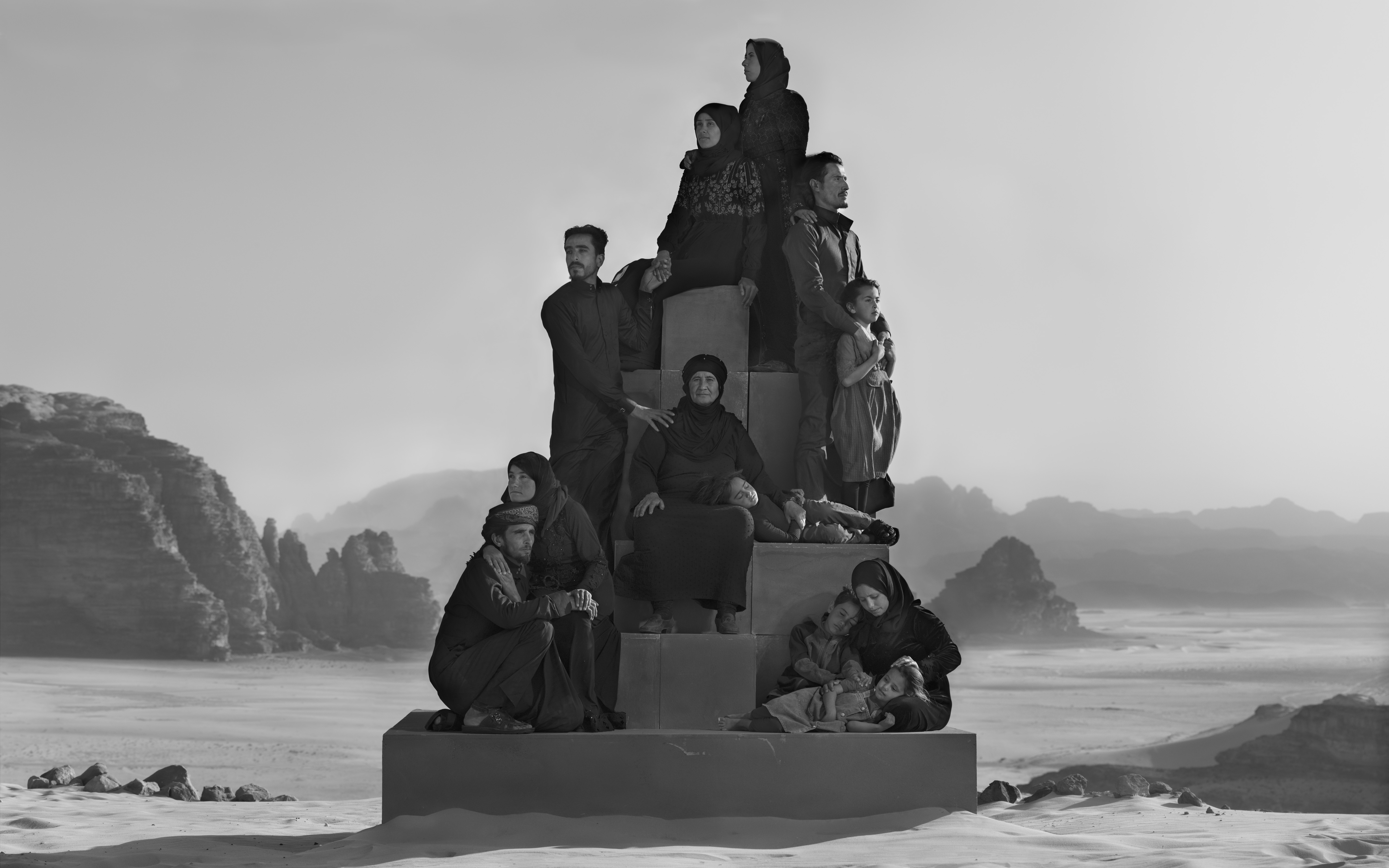
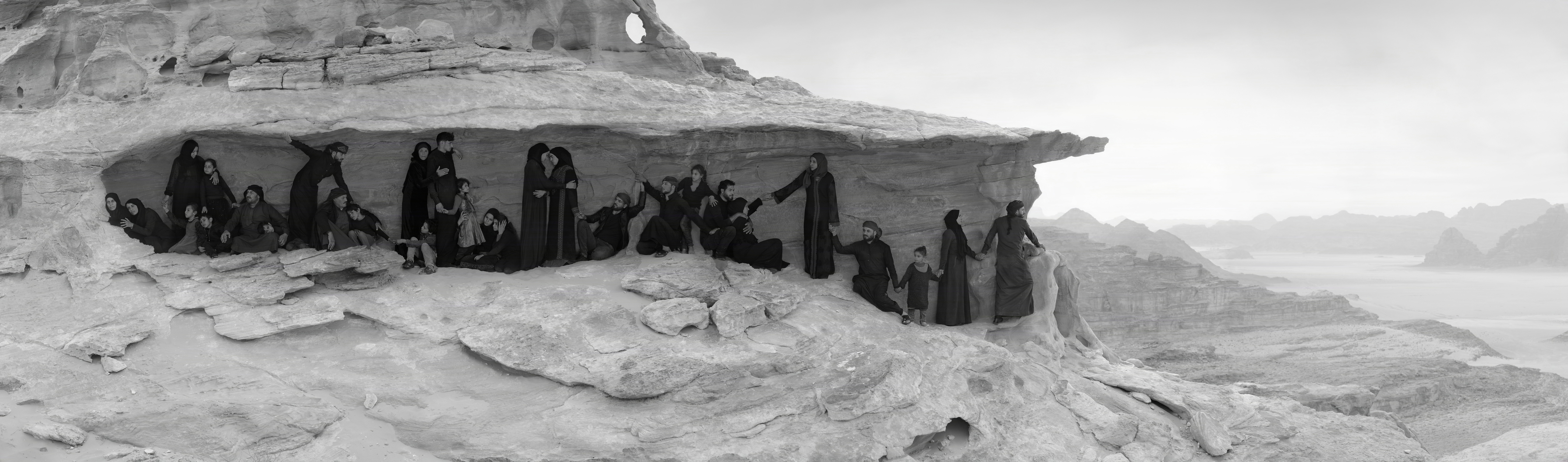
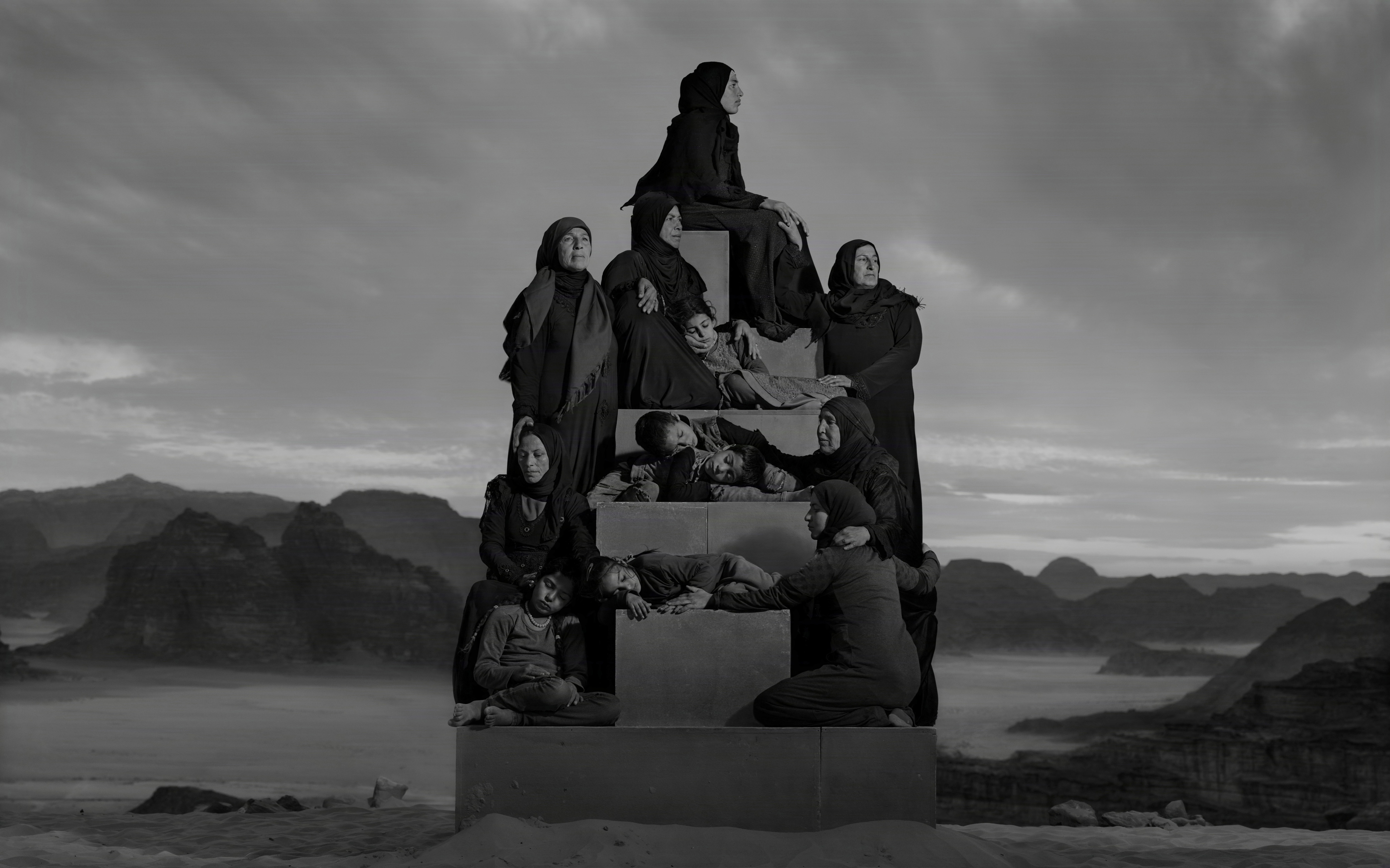
In front of a bare and minimalist background where sand and rocks draw the lines, Nick places the family members in different intertwined forms: couples, siblings, mothers and daughters, husbands and brothers, elders and children sit or stand on cleverly placed boxes, in a harmonious ensemble that resembles a group statue. Every individual becomes a protagonist. The first visual impression is of a dignified sense of connectedness, strength, and presence.
In their daily lives they are struggling, not only because of their refugee status, but also due to climate change and its consequences for their agricultural practice and livelihood. Most are concerned about the impossibility of offering their children a decent future. Many were kids themselves when they left their home, escaping the rage and fury of a war that had no mercy.
And then the world forgot about them.
With Nick’s project and their participation in its making they become visible.
They are there, tall and proud.
We see them.
Most of the people in these powerful, sculptural portraits wear traditional clothes that flow together with embracing arms and interlocked hands. They become one. The vision of the whole is striking.
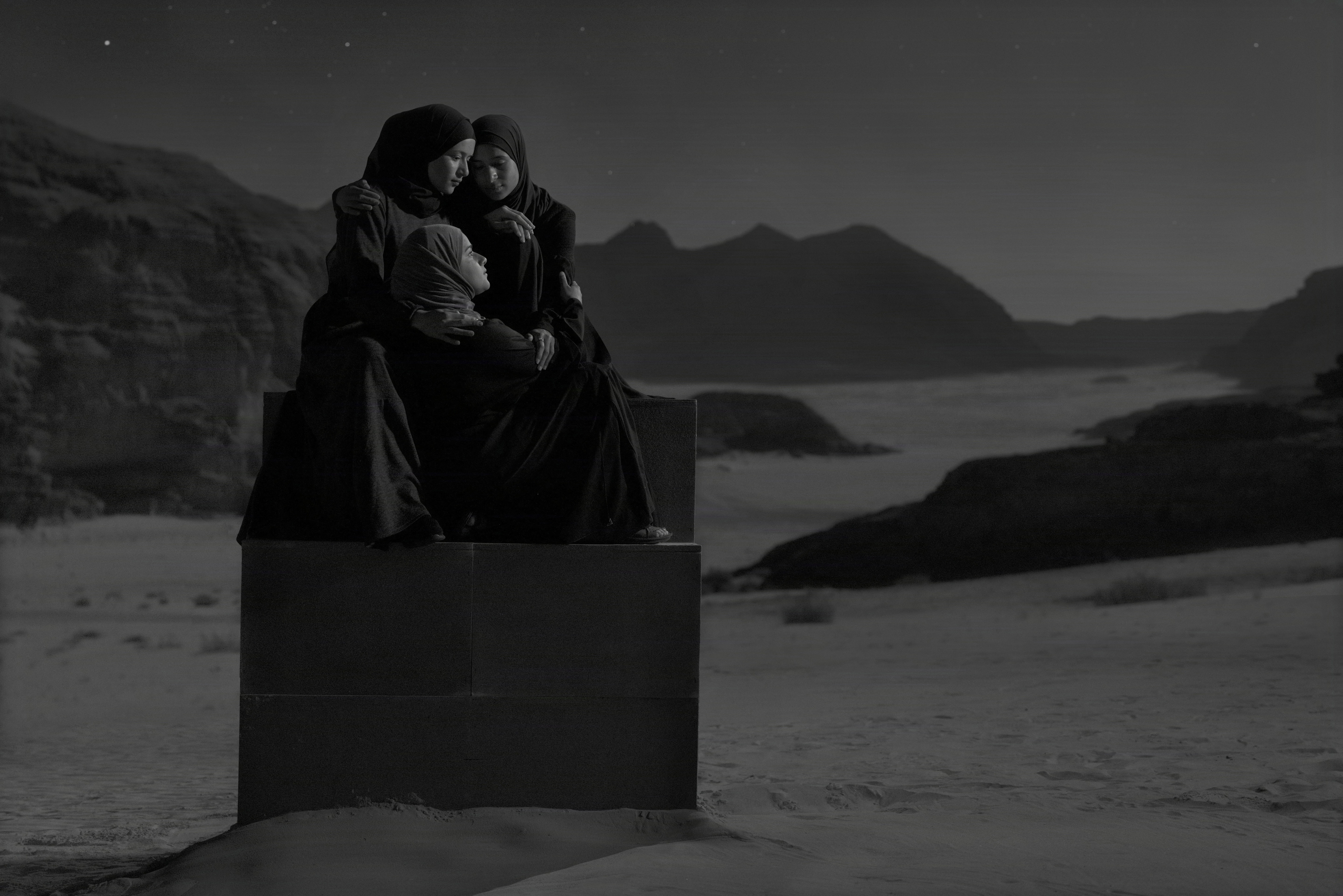
Then our glance begins to focus on the individuals, the parts of this unity. It lingers on faces, eyes closed or open, looking out or at the camera, caressed by the wind or the moonlight. We are taken in swiftly but softly and we wonder what their stories are, what they were thinking while being photographed, what they might be thinking now, as new opportunities might arrive for their families’ future.
There are many women among the portrayed, at times holding hands with other women and children, as well as embracing husbands and fathers: the power of the image is the connection, the strong relation that holds them all together. They are supporting and protecting each other. They form a compact unity where toughness and tenderness are fused.
The shape of this union rings another bell in the myriad of images and visual ideas in my mind. I think of mountains, the ancient, solid shapes of this Earth that rise high above all other beings. The symbolism of the mountain is a shared notion in many cultures.
From Greek mythology to Dante, from various religious traditions to universal metaphysical concepts, the mountain offers a broad spectrum of meaning that we can adopt in observing Nick’s images.
Mountains are a symbol of ascension and elevation.
The mountain is “axis mundi,” the center, the temple, the pillar.
The mountain is Mother.
Religion and spirituality aside, the climb to the top is a metaphor for overcoming challenges, practicing perseverance, reaching our destination, fulfilling our dreams.
Mountains are stable and still.
They symbolize hopes and desires.
A goal to be reached. In Nick’s portrayal of these families, I recognize the towering presence of mountains. I feel the resilience nurtured by the stories of these people, by the longing for their homeland, the firmness of their wishes, and the strength of their togetherness.
To create this compact sense of space, Nick uses a simple, humble object: a number of imperfect, handcrafted, sand-washed crates which are variously composed to create a stage on which the scene can take place, the characters can enter their spotlight.
These boxes are the pedestals that elevate each and every individual in their group-like formations.
They are the bricks of their houses that have been destroyed back home and have to be rebuilt again.
They are the makeshift cardboard boxes that shelter this planet’s homeless.
They are the foundation of the future.
They hold their precious dreams.